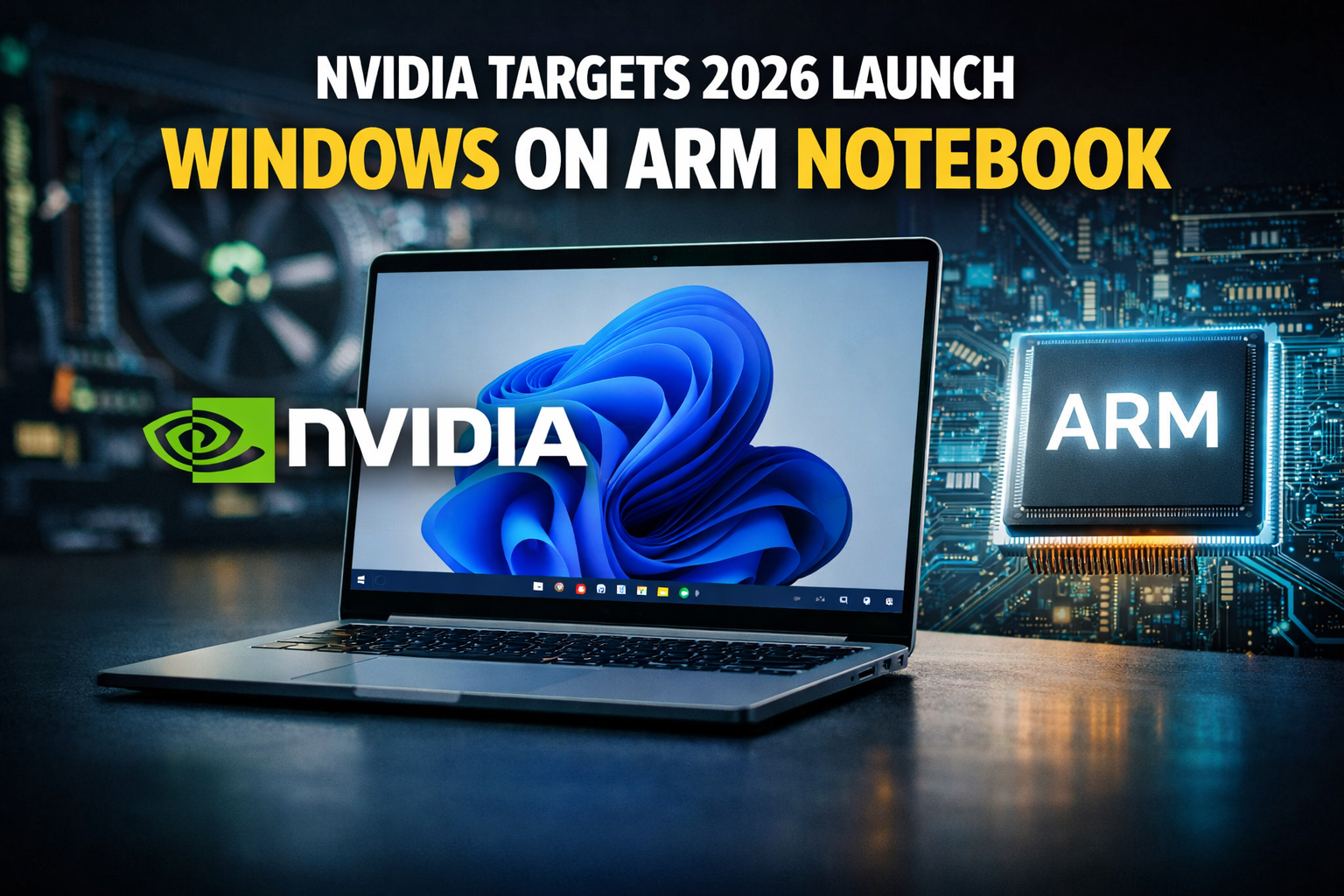
In a move that could significantly reshape the Windows PC ecosystem, Nvidia is targeting a 2026 launch for its first Windows on Arm notebook platform, according to industry sources familiar with the company’s plans. The effort marks Nvidia’s most serious push yet into consumer PC processors and positions the AI chip leader to challenge Apple’s MacBooks and Qualcomm’s growing Snapdragon X lineup.
Nvidia’s Strategic Return to the PC CPU Market
Nvidia is best known for its dominance in GPUs and data-center AI accelerators, but the company has long shown interest in Arm-based CPUs. Its previous attempt to acquire Arm in 2020 ultimately failed due to regulatory opposition, yet Nvidia has continued to invest heavily in Arm-based designs for servers, automotive systems, and embedded computing.
A Windows on Arm notebook platform would represent Nvidia’s return to the mainstream PC market—this time with a focus on power efficiency, AI acceleration, and tight CPU-GPU integration. Sources suggest the 2026 timeline reflects Nvidia’s intention to deliver a highly optimized, next-generation system-on-chip (SoC) rather than a rushed first product.
Why Windows on Arm Matters in 2026
Windows on Arm has gained renewed momentum over the past two years, driven largely by Qualcomm’s Snapdragon X Elite and X Plus chips. These processors have demonstrated that Arm-based Windows laptops can finally compete with x86 systems on performance per watt while offering all-day battery life.
Nvidia’s entry could accelerate this transition. By combining Arm CPU cores with Nvidia’s industry-leading graphics and AI IP, the company could offer:
- Significantly stronger GPU performance than existing Arm-based Windows laptops
- Advanced on-device AI features, including generative AI workloads
- Improved gaming capabilities, an area where Windows on Arm has traditionally lagged
Potential Competition with Apple and Qualcomm
If Nvidia meets its 2026 target, it will face stiff competition. Apple’s M-series chips continue to set the benchmark for Arm-based laptops, while Qualcomm is expected to be on its second or third generation of Snapdragon X processors by then.
However, Nvidia’s advantage lies in its software ecosystem and AI leadership. CUDA, RTX technologies, and deep learning frameworks could be adapted to give Nvidia-powered Windows notebooks a unique value proposition—particularly for creators, developers, and AI-focused professionals.
OEM Partnerships and Market Impact
Industry observers expect Nvidia to work closely with major PC manufacturers rather than releasing its own branded notebook. Potential partners could include established Windows OEMs seeking differentiation in a market that has become increasingly commoditized.
A successful launch could also put pressure on Intel and AMD, whose x86 dominance in laptops is already being challenged by Arm’s rapid gains in efficiency and performance.
Looking Ahead
While details remain limited and Nvidia has not publicly confirmed its plans, a 2026 Windows on Arm notebook launch would align with broader industry trends toward AI-first, power-efficient computing. If executed well, Nvidia’s move could become one of the most disruptive shifts in the PC market since Apple’s transition to Apple Silicon.
For now, all eyes are on how Nvidia blends its AI and graphics expertise into a Windows on Arm platform—and whether it can redefine what a Windows notebook looks like in the second half of the decade.
Advantages of Nvidia’s Windows on Arm Notebook Strategy
Nvidia’s planned entry into the Windows on Arm notebook market brings several strategic and technological advantages that could reshape the PC industry.
1. Superior AI Performance
Nvidia’s leadership in artificial intelligence is its biggest advantage. A Windows on Arm notebook powered by Nvidia silicon would likely feature dedicated AI engines, Tensor Cores, and optimized neural processing, enabling advanced on-device AI tasks such as real-time content creation, voice processing, and generative AI—without relying heavily on the cloud.
2. Industry-Leading Graphics Capabilities
Unlike current Arm-based Windows laptops, Nvidia can deliver significantly stronger GPU performance. Its expertise in graphics could dramatically improve gaming, 3D rendering, video editing, and creative workloads—areas where Windows on Arm has historically underperformed.
3. High Performance per Watt
Arm architecture is known for efficiency, and Nvidia has years of experience designing power-efficient SoCs for data centers, automotive systems, and embedded devices. This combination could result in longer battery life, cooler systems, and thinner notebook designs.
4. Tight CPU, GPU, and AI Integration
Nvidia excels at building tightly integrated platforms. A unified architecture combining Arm CPU cores, Nvidia GPUs, and AI accelerators would deliver better system optimization, faster data sharing, and lower latency, giving it an edge over modular x86 designs.
5. Strong Software and Developer Ecosystem
Nvidia’s mature software stack—CUDA, RTX, AI SDKs, and developer tools—could be extended to Windows on Arm. This would encourage faster app optimization and better native Arm software support, solving one of the platform’s long-standing challenges.
6. Competitive Pressure on Intel and AMD
Nvidia’s entry would intensify competition in the notebook CPU market, potentially driving faster innovation, better pricing, and more diverse hardware options for consumers and enterprises alike.
7. Attractive Option for OEMs
PC manufacturers are seeking differentiation as the laptop market becomes more competitive. Nvidia-powered Windows on Arm notebooks could offer premium performance, AI features, and branding appeal, making them attractive to top OEM partners.
8. Future-Proof Computing Platform
With AI becoming central to operating systems and applications, Nvidia’s approach aligns well with Microsoft’s AI-first vision for Windows. A 2026 launch positions Nvidia to deliver next-generation notebooks built for AI workloads from the ground up.
Cost Considerations for Nvidia’s Windows on Arm Notebook
While Nvidia’s push into the Windows on Arm notebook space promises performance and efficiency gains, cost will be a key factor shaping adoption for both manufacturers and buyers. Below are the major cost-related aspects tied to Nvidia’s anticipated 2026 launch:
1. Premium Silicon Pricing
Nvidia’s chips are typically positioned at the upper end of the market due to advanced features like integrated AI accelerators and high-end GPUs. This means the processor itself may carry a higher unit cost compared with standard Arm SoCs used in existing Windows laptops, potentially increasing the base price of devices.
2. Development and Integration Costs
Building a new platform from the ground up—especially one that merges CPU, GPU, and AI capabilities—requires substantial investment in:
- Hardware design and testing
- Software compatibility and optimization
- Firmware and driver support
These R&D costs may be factored into OEM pricing strategies, particularly in the early years of production.
3. OEM Pricing Premium
PC manufacturers often position cutting-edge models at a premium to protect margins and signal performance leadership. Nvidia-powered notebooks, with their advanced capabilities, could be marketed similarly to high-end ultrabooks or creative professional laptops, which typically command higher retail prices.
4. Impact on Consumer Pricing
For end users, this could translate to:
- Higher starting prices compared with entry-level Windows laptops
- A possible $200+ premium over comparable Snapdragon or Intel/AMD spec machines (based on trends in high-end silicon pricing)
However, the exact pricing will depend on market dynamics in 2026, competition from Qualcomm and other Arm vendors, and Nvidia’s own cost strategy.
5. Value Justification Through Features
Although initial prices may be higher, Nvidia’s platform could deliver greater value per dollar for buyers who need:
- Advanced AI computing
- Premium graphics performance
- Long battery life
- Enhanced productivity and creative workflows
This feature-to-cost equation could help justify a premium position in the market.
6. Total Cost of Ownership (TCO)
Arm-based platforms—especially those optimized for efficiency—often offer savings over time through:
- Lower energy consumption
- Reduced cooling requirements
- Potentially longer usable lifespan
For businesses and power users, the lower operational cost can offset a higher upfront purchase price.
Bottom Line
While Nvidia’s Windows on Arm notebooks may enter the market at a higher price point, the combination of cutting-edge AI, GPU performance, and power efficiency could deliver meaningful value—especially for creative professionals, developers, and enterprise buyers who prioritize performance over sticker price.
Here is a direct Amazon link where you can browse and buy laptops online:
👉 Amazon Best Sellers – Laptop Computers
This page shows top laptop listings on Amazon, where you can choose and buy the model you want.
⚠️ Note: Amazon does not ship directly to Pakistan in many cases, so you may need to use shipping services or third-party support to get products delivered locally.