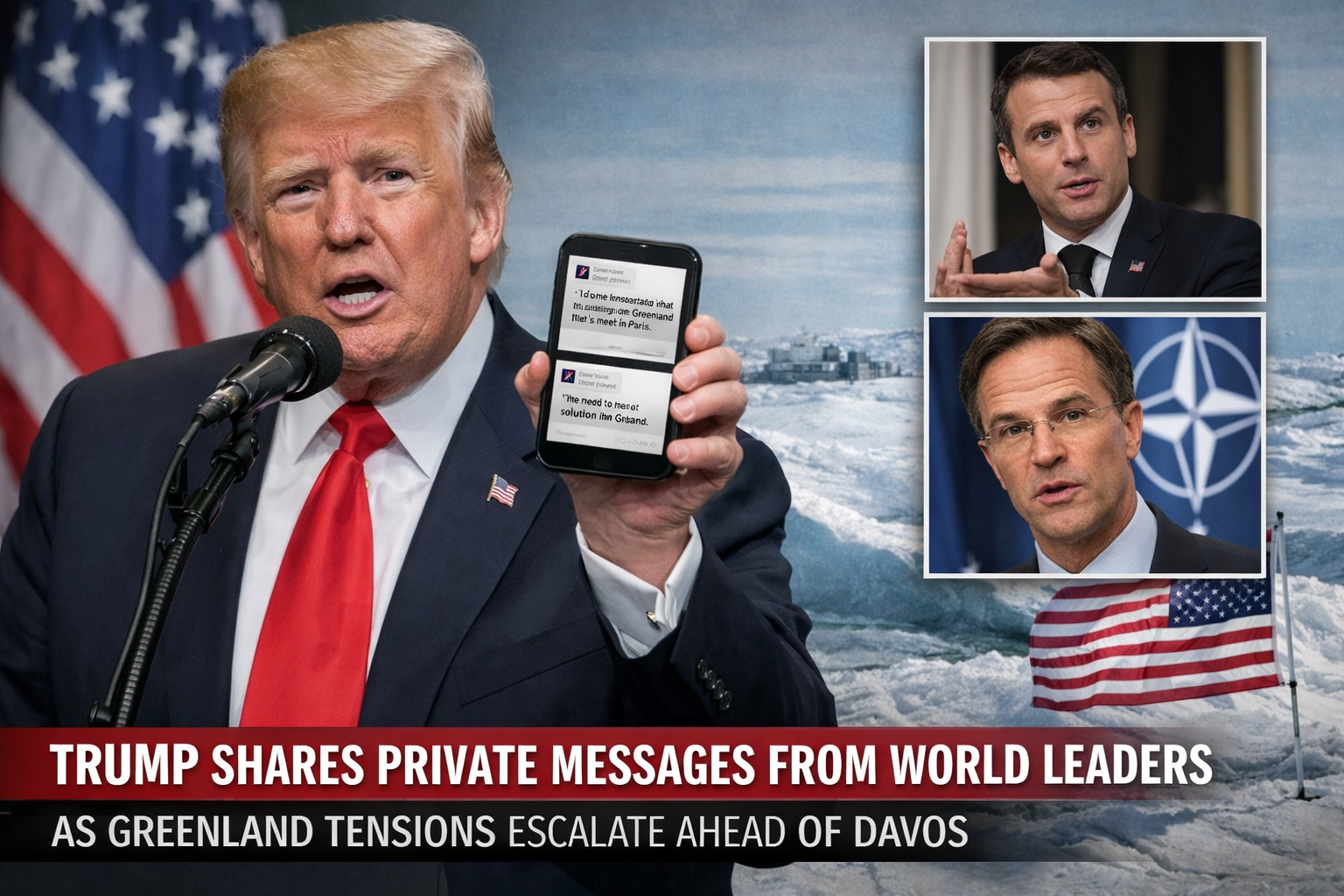
Global diplomatic relations have taken a dramatic turn this week as U.S. President **Donald Trump publicly shared what appear to be private text messages from French President Emmanuel Macron and **NATO Secretary General Mark Rutte — bringing internal diplomatic conversations into the spotlight and intensifying an already contentious dispute over the future of Greenland.
The timing of these disclosures adds fuel to geopolitical tensions just days before the World Economic Forum in Davos, Switzerland, where world leaders are set to convene under the theme “A Spirit of Dialogue.” Western allies are scrambling to respond to Trump’s aggressive posture on Arctic strategy, trade policy, and global diplomacy.
What Messages Were Shared — And Why It Matters
On January 20, Trump took to his social media platform Truth Social to post screenshots of messages he says were sent to him by Macron and Rutte.
In the message attributed to Macron, the French president addressed Trump as “my friend,” saying the two leaders were “totally in line on Syria” and that “We can do great things on Iran”, before sharply questioning Trump’s focus on Greenland. Macron wrote: “I do not understand what you are doing on Greenland.”
He went on to propose a Group of Seven (G7) meeting in Paris later this week after the Davos forum, suggesting an unusually broad group of invitees including Ukrainians, Danes, Syrians and Russians — and offered to host Trump for dinner in Paris.
In the message attributed to Rutte, NATO’s chief expressed support for Trump’s work in Syria, Gaza and Ukraine and said he was “committed to finding a way forward on Greenland.”
Trump did not publish his replies with the screenshots. Representatives from the French presidency and NATO have not publicly confirmed the contents of the messages, though some sources close to Macron acknowledged that the text sent to Trump appears authentic.
The Greenland Issue: Strategic Stakes and Transatlantic Rift
Trump has made control of Greenland — a large, semi‑autonomous territory of Denmark — a central focus of his foreign policy, insisting that the United States should acquire it. Trump argues that U.S. possession of the Arctic island is vital to national and global security, particularly to counter the influence of Russia and China in the High North.
European leaders have consistently rejected the idea that Greenland is for sale, reaffirming that it is part of the Kingdom of Denmark and that its people must decide their own future. Denmark and its allies have stepped up military deployments and symbolic support in the region.
The dispute has already spilled into economic policy. Trump announced punitive tariffs: 10% on goods from multiple European countries starting February 1, rising to 25% after June 1 if Greenland discussions fail to progress, and separately threatened a 200% tariff on French wine and champagne, in what he described as leverage to bring France on board with his broader strategic initiatives.
Backlash and Broader Repercussions
European officials and analysts have decried both Trump’s aggressive rhetoric and his decision to make private diplomatic communications public. Many see these actions as eroding trust and undermining decades of cooperative transatlantic diplomacy.
French officials have reportedly labeled Trump’s tariff threats as “unacceptable,” and EU leaders are preparing an emergency summit in Brussels to coordinate responses and possible counter‑measures.
Beyond trade and diplomacy, the controversy has contributed to volatility in global markets, with traders reacting to the heightened risk of U.S.–Europe economic conflict.
Analysts also warn that the dispute creates openings for strategic competitors — particularly Russia and China — to exploit divisions within NATO and the EU. The Arctic, long a region of geopolitical interest, is rapidly becoming a focal point of rival great‑power competition.
Davos Looms Large
The World Economic Forum, historically centered on economic cooperation, is now overshadowed by this diplomatic crisis. Leaders attending Davos will have to balance discussions on climate, global economic growth and cooperation with urgent negotiations over security, sovereignty and geopolitical alliances.
Macron is expected to attend, but aides say there are no plans for a formal meeting with Trump during the forum. Meanwhile, Trump has signaled that Greenland will be a topic of discussion at Davos, even as some European representatives emphasize the need to de‑escalate and seek dialogue.
What Comes Next
With emergency EU meetings, high‑level summits and global market anxieties converging, the Greenland dispute could reshape not only Arctic geopolitics but also transatlantic relations for years to come. Trump’s unprecedented public release of private diplomatic communications marks a new chapter in how interstate disputes are aired — and how fragile alliances may be tested under pressure.