In an era where digital transformation drives industries, digital twin technology has emerged as a groundbreaking innovation, bridging the physical and digital worlds. From manufacturing floors to smart cities, digital twins are reshaping how businesses design, operate, and maintain complex systems.
What Is a Digital Twin?
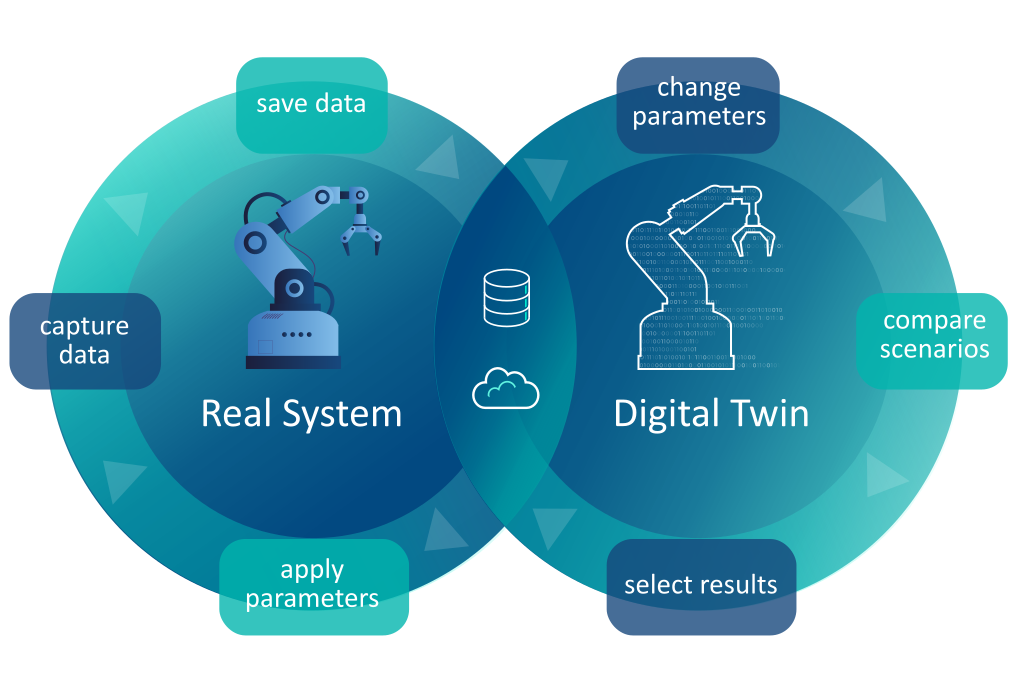
A digital twin is a virtual replica of a physical object, system, or process. It mirrors the characteristics, behaviors, and dynamics of its real-world counterpart using data collected through sensors, IoT devices, and other monitoring technologies. Unlike simple simulations, digital twins continuously update and evolve in real time, providing an accurate, dynamic representation of the physical entity.
How Digital Twins Work
Digital twin technology relies on several core components:
- Data Acquisition: Sensors and IoT devices capture real-time data from the physical system.
- Data Processing and Analytics: Advanced algorithms process this data to simulate behavior, predict outcomes, and identify anomalies.
- Visualization: Interactive dashboards, 3D models, and AR/VR interfaces allow stakeholders to explore the digital twin intuitively.
- Feedback and Optimization: Insights from the digital twin can be fed back into the physical system for improved performance, maintenance, and innovation.
For example, a manufacturing company might use a digital twin of its production line to predict equipment failures, optimize workflows, or test new processes without risking downtime.
Applications Across Industries
Digital twins are no longer confined to industrial settings—they are revolutionizing multiple sectors:
- Manufacturing: Optimize assembly lines, predict maintenance needs, and improve product designs.
- Healthcare: Model human organs or patient data to simulate treatment outcomes and personalize care.
- Smart Cities: Monitor traffic, energy usage, and infrastructure health to improve urban planning.
- Automotive and Aerospace: Test vehicles in virtual environments to ensure safety, efficiency, and reliability.
- Energy and Utilities: Monitor grids, predict equipment failures, and optimize renewable energy deployment.
Benefits of Digital Twin Technology
- Predictive Maintenance: Reduces downtime by anticipating failures before they occur.
- Cost Efficiency: Virtual testing reduces the need for physical prototypes and trials.
- Enhanced Decision-Making: Real-time data provides actionable insights for better operational choices.
- Innovation Enablement: Allows rapid experimentation and product optimization in a risk-free environment.
- Sustainability: Optimizes resource usage and reduces waste by simulating scenarios before implementing them physically.
Challenges and Considerations
Despite its advantages, digital twin adoption comes with challenges:
- Data Security and Privacy: High volumes of sensitive data are transmitted and stored digitally.
- Integration Complexity: Incorporating digital twins into existing legacy systems can be difficult.
- High Initial Costs: Investment in sensors, platforms, and analytics tools can be significant.
- Standardization: Lack of universal standards may create interoperability issues.
The Future of Digital Twins
The digital twin market is rapidly expanding, driven by advancements in AI, machine learning, cloud computing, and 5G networks. Future digital twins will likely evolve beyond individual objects to represent entire ecosystems—integrating humans, machines, and environments in real time. This “system-of-systems” approach could transform industries, urban planning, and even personalized healthcare at unprecedented scales.
Conclusion
Digital twin technology represents a fundamental shift in how we design, monitor, and optimize the physical world. By creating a living digital counterpart, organizations can make smarter decisions, enhance efficiency, and unlock innovative possibilities. As the technology matures, its influence will extend from individual machines to entire cities, making digital twins a cornerstone of the connected, intelligent future.